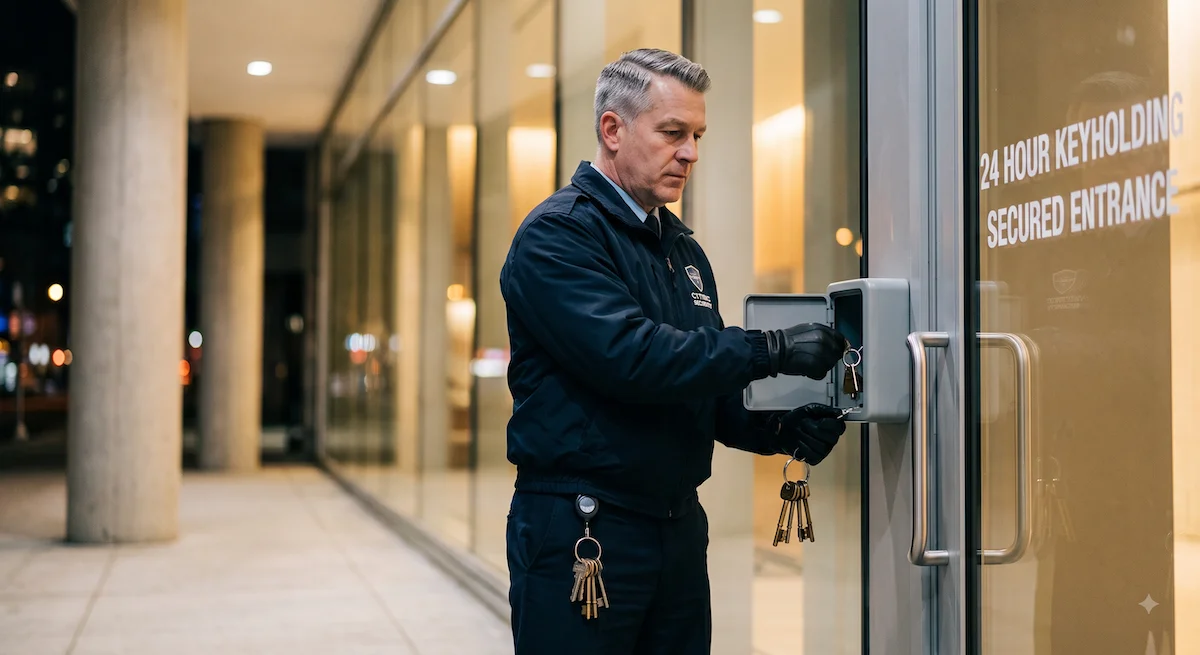
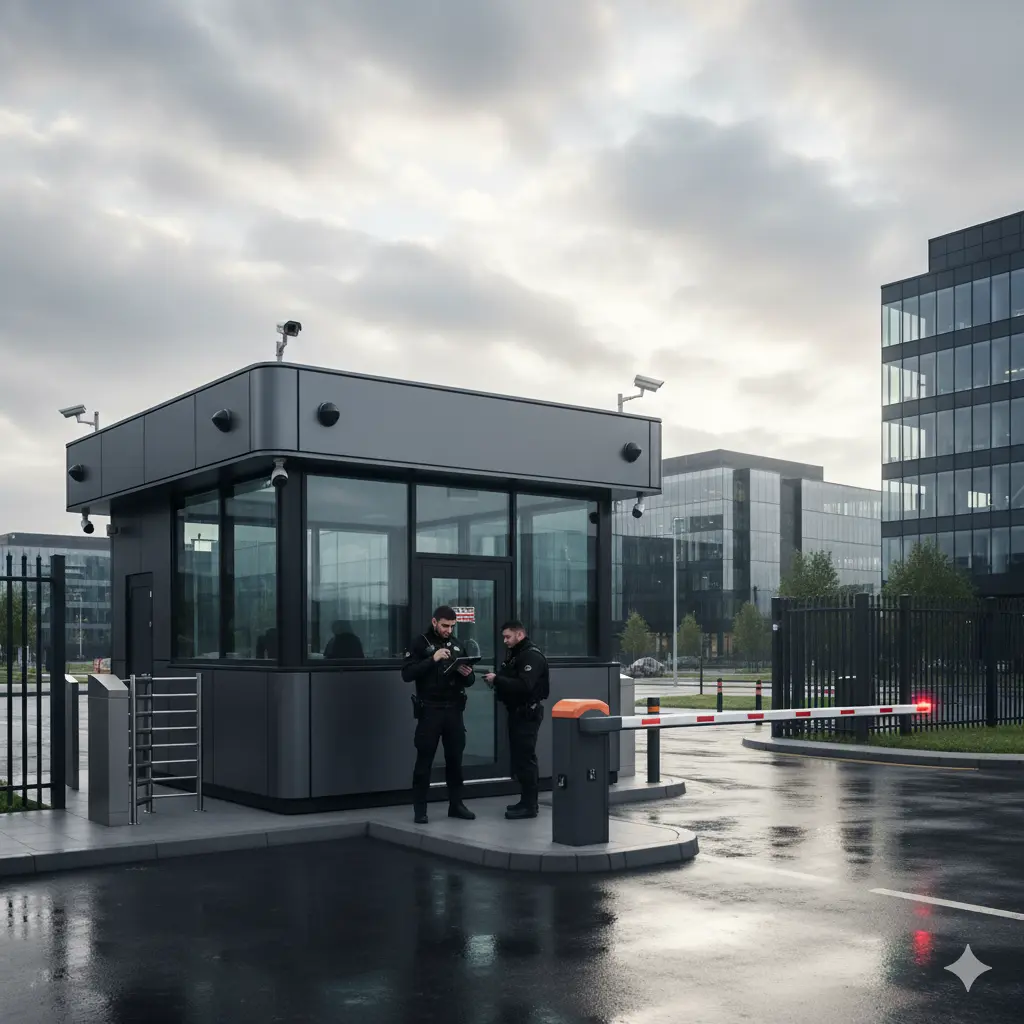
Gatehouse security is a specific, high-visibility form of static security in which a trained, SIA-licensed officer is positioned at the main entry point of a site — typically a gatehouse, barrier, or staffed entrance — to control all access to the premises.
It is most commonly associated with industrial estates, business parks, distribution centres, and large commercial developments, where managing who enters and exits a site is as important as what happens inside it. This guide explains what gatehouse security involves, which sites need it, and how to choose the right provider.
What Does a Gatehouse Security Officer Do?
A gatehouse security officer’s primary function is site access control — but in practice the role covers a range of related responsibilities:
- Vehicle and pedestrian access management. Checking the authorisation of every vehicle and person arriving at the site, verifying identity against visitor lists or contractor registers, and either clearing or refusing access according to site procedures.
- Visitor and contractor logging. Maintaining an accurate, contemporaneous record of every arrival and departure — including vehicle registration numbers, visitor names, host contacts, and the time in and out. This record is essential for emergency evacuations, insurance purposes, and security investigations.
- Contractor management. Ensuring that contractors arriving on site hold valid permits to work, are signed in correctly, and are briefed on site safety and security rules before proceeding.
- Barrier and gate operation. Operating manual or electronic barriers, vehicle-activated bollards, or ANPR-linked systems — and making real-time decisions about access where automated systems cannot.
- CCTV monitoring at the entry point. Many gatehouse positions include CCTV coverage of the site perimeter, approach roads, and parking areas. The gatehouse officer monitors these feeds and acts on anything identified in real time.
- Incident response. If an unauthorised person attempts to enter, a conflict arises at the entry point, or a security incident is observed in the perimeter area, the gatehouse officer is the first responder. They manage the immediate situation and escalate as required.
- Shift reporting. A detailed gatehouse log is maintained throughout the shift and handed over to the relief officer or management at the shift end.
Which Sites Use Gatehouse Security?
Industrial Estates and Manufacturing Sites
Large industrial sites with multiple buildings, high-value plant and equipment, and significant vehicle movements require formal access management. A gatehouse position at the main entrance controls every vehicle and pedestrian entering the estate, prevents unauthorised access, and creates a clear record of site activity.
Across the North West — from the M60 industrial corridor around Manchester to the logistics zones around Wigan and Warrington — gatehouse security is the standard model for large industrial site access control.
Business Parks and Commercial Developments
Multi-tenanted business parks present a specific challenge: many occupants, many contractors, and often a public-facing element (café, gym, car park) that needs to coexist with restricted-access areas. A professionally staffed gatehouse manages this complexity in a way that automated barriers or CCTV alone cannot.
Distribution Centres and Logistics Hubs
High-value cargo movements, large numbers of visiting HGVs, and shift patterns spanning 24 hours make logistics sites one of the most demanding security environments. Gatehouse officers at distribution centres manage inbound and outbound vehicle movements, verify driver identity and load documentation, and maintain a full vehicle log for each operational period.
Retail Parks
Major retail parks with significant footfall, delivery vehicle movements, and after-hours security requirements often deploy gatehouse security at service entrances and staff car parks, managing contractor access and out-of-hours activity separately from the public-facing areas of the development.
Healthcare, Education, and Public Sector Campuses
Large NHS sites, university campuses, and local authority facilities require careful access management — particularly when some areas are public and others are restricted. Gatehouse security at entry points allows public access to visitor-facing areas to continue while protecting clinical, administrative, or sensitive areas.
Gatehouse Security vs Reception Security vs Concierge: What Is the Difference?
These three roles are often confused because all three involve managing access to a building or site — but they operate in very different environments and with different priorities.
Gatehouse security is primarily an access control and site perimeter function, deployed at the physical entry point to a large site. The environment is typically external or semi-external — a barrier, a cabin, or a staffed entry gate. The gatehouse officer’s priority is controlling vehicle and pedestrian access to the wider site.
Reception security is deployed at the internal entrance to a building — typically the main reception desk of an office, public building, or commercial premises. The officer manages access into the specific building, but the wider site has already been accessed by the time someone reaches reception.
Concierge security combines security with a service role, typically in residential buildings, hotels, or high-end commercial properties. A concierge security officer manages access and responds to incidents, but also handles resident enquiries, manages deliveries, and provides a front-of-house service that a gatehouse officer would not.
Access Control Technology Alongside Gatehouse Security
A staffed gatehouse works most effectively when it is supported by technology that extends the officer’s awareness and capability:
- ANPR (Automatic Number Plate Recognition). ANPR cameras at the gatehouse entry record every vehicle registration automatically. Vehicles on a pre-approved list can be flagged; unknown or flagged plates alert the officer before the vehicle reaches the barrier.
- Electronic visitor management systems. Digital systems allow gatehouse officers to check visitors in against pre-registered lists, issue time-limited passes, and generate an automatic entry log — replacing paper-based visitor books with a searchable, auditable record.
- Barrier and bollard integration. Electronically operated barriers and rising bollards that the gatehouse officer controls directly allow them to manage vehicle flow without leaving their post.
- Intercom and CCTV. Remote CCTV coverage of the approach road and car park, combined with a gatehouse intercom, allows the officer to screen visitors and manage pedestrian access from their fixed position.
The combination of a trained, licensed officer and integrated technology creates a gatehouse operation that is both more effective and more efficient than either approach alone.
What to Look for in a Gatehouse Security Provider
- SIA licensing as a baseline. Every officer in a gatehouse role must hold a valid SIA Security Guarding licence. Confirm this before any deployment.
- Experience in your site type. Gatehouse security at a construction site is materially different from a managed business park. Ask about the provider’s experience with your specific environment and the types of access control procedures they have operated.
- Clear briefing and handover processes. A gatehouse officer who does not know your site rules, visitor procedures, or permitted vehicles is a security risk. Ask how the provider briefs officers before deployment and how shift handovers are managed.
- Robust reporting. The gatehouse log is a legal document in the event of an incident, an insurance claim, or an emergency evacuation. Make sure you understand what you will receive after every shift and confirm the format meets your requirements.
Gatehouse Security Across the North West
Radius Security provides gatehouse security service for industrial estates, business parks, distribution centres, and commercial developments across Greater Manchester, Wigan, Warrington, Bolton, and the wider North West. All officers are SIA-licensed, and we work with site managers to develop site-specific briefing documents, visitor management procedures, and handover protocols before any deployment begins.
Frequently Asked Questions
Gatehouse security is typically priced per officer per hour, with rates depending on the shift pattern, site requirements, and whether 24/7 cover is needed. Most gatehouse deployments involve multiple officers to cover day, evening, and overnight shifts. Radius Security provides free, tailored quotes based on your site’s access hours and specific requirements — contact us to discuss
Yes. A gatehouse security officer is authorised by the site owner or operator to refuse access to anyone who cannot verify their authorisation, does not have a valid appointment, or presents a security concern. The officer is acting on behalf of the site occupier in exercising this authority. In practice, a professional gatehouse officer manages this tactfully — most refusals are handled calmly and without confrontation.
A gatehouse is positioned at the entry point to a site — typically a barrier or gate controlling access to the wider premises. A receptionist or reception security officer operates inside a building, managing access to that specific building once the wider site has already been accessed. In large business parks or industrial estates, you may have both: a gatehouse controlling site access and a reception controlling building access within the site.
Yes. A gatehouse officer carrying out access control and security functions at a UK site must hold a valid SIA Security Guarding licence. Radius Security confirms all officers’ SIA licence status before any deployment. You can also check individual officers’ licences on the SIA’s public register at sialic.org.uk.